WEIGHT HARDER TO MANAGE THAN IT USED TO BE?
For women over 40 navigating hormonal weight change
During perimenopause and menopause, weight may become easier to gain even when your eating and activity habits haven't changed.
Explore what may be influencing weight, energy and eating patterns with a structured consultation.
WEIGHT HARDER TO MANAGE THAN IT USED TO BE?
For women over 40 navigating hormonal weight changes.
During perimenopause and menopause, weight may become easier to gain even when your eating and activity habits haven't changed.
Explore what may be influencing weight, energy and eating patterns with a structured consultation.
When Your Body No Longer Feels Predictable
If this feels familiar:
Your usual habits are still there, but the results no longer feel predictable.
Weight fluctuations seem to happen more easily than they once did.
Energy feels less consistent, sleep is lighter, and recovery takes longer than it once did.
Advice about food, weight and metabolism that once seemed straightforward now feels confusing or inconsistent.
Food decisions take up more mental space than they used to.
You’re starting to sense this isn’t simply about discipline or motivation anymore.
For many women over 40, this is the point where the old rules start to feel less reliable.


It's not your fault
Your body is responding differently to the way it used to.
What once felt straightforward now take more effort to maintain.
Putting in more effort hasn’t always made it clearer what actually works.
Very few women are prepared for this shift before it happens.
This isn’t a personal failure. It’s a common experience that's rarely talked about.
When Your Body No Longer Feels Predictable
If this feels familiar:
Your usual habits are still there, but the results no longer feel predictable.
Weight fluctuations seem to happen more easily than they once did.
Energy feels less consistent, sleep is lighter, and recovery takes longer than it once did.
Advice about food, weight and metabolism that once seemed straightforward now feels confusing or inconsistent.
Food decisions take up more mental space than they used to.
You’re starting to sense this isn’t simply about discipline or motivation anymore.
For many women over 40, this is the point where the old rules start to feel less reliable.

It's not your fault
Your body is responding differently than it used to.
What once felt straightforward now takes more effort to maintain.
Putting in more effort hasn’t always made it clearer what actually works.
Very few women are prepared for this shift before it happens.
This isn’t a personal failure. It’s a common experience that’s rarely talked about.
Did You Know?
During midlife, changes in sleep timing and circadian regulation become more common and are associated with altered glucose regulation, insulin sensitivity, and energy metabolism in women, independent of calorie intake.¹
Across the menopausal transition, shifts in appetite-regulating hormones and central reward signalling (including ghrelin- and GLP-1–related pathways) are linked to changes in hunger perception, food motivation, and eating behaviour.²
Repeated cycles of dieting are associated with compensatory metabolic and behavioural responses that become more pronounced with age, reducing the effectiveness of strategies that previously worked in earlier adulthood.³
Outcomes observed in individualised nutrition programs are more strongly associated with adherence, structure, and practitioner support than with diet composition alone, particularly in adults with prior weight-loss resistance.⁴
What Happens After The Strategy Session?
The strategy session creates clarity by identifying which factors are most relevant now. For many women who decide to continue with structured support the next step is our program, Mind Your Weight.
Understand Your Body
Look at how your body is functioning now and what has changed compared to earlier stages of life.
Personalised Nutrition
Use blood pathology to inform a nutrition plan personalised for you, including which foods should be included, limited, or avoided..
Daily Routines
Work with everyday routines that affect eating and follow-through, so the approach can be applied in daily life.
This is not a generic plan. It is a structured, personalised process designed to be used in real life, based on how your body functions now.
Metabolic Balance® The System Behind Mind Your Weight
Mind Your Weight incorporates Metabolic Balance®, a structured, data-driven nutrition method supported by peer-reviewed research4. It generates personalised nutrition plans informed by individual blood chemistry and health information, and is used in clinical contexts where individualisation and practitioner oversight are central to the process.
This approach aligns with evidence demonstrating substantial inter-individual variability in metabolic and lipid responses to food, supporting the use of blood-marker–informed nutrition and practitioner-guided individualisation rather than uniform dietary prescriptions3,5,6.
Evidence from a peer-reviewed observational study suggests that outcomes within the Metabolic Balance® program are closely linked to individualisation, adherence, and practitioner support rather than diet alone⁴.
The method uses measurable biological data to inform food choices at an individual level. The nutrition process involves:
A comprehensive intake and health history
Blood pathology and analysis of 36 health markers
Generation of a personalised nutrition plan
The program uses real food, prepared in familiar ways and tailored to your preferences.
Metabolic Balance® is recognised by some health funds, medical practitioners and is listed with the Therapeutic Goods Administration (TGA) of Australia.
Metabolic Balance® The System Behind Mind Your Weight
Mind Your Weight incorporates Metabolic Balance®, a structured, data-driven nutrition method supported by peer-reviewed research⁴. It generates personalised nutrition plans informed by individual blood chemistry and health information, and is used in clinical contexts where individualisation and practitioner oversight are central to the process.
This approach aligns with evidence demonstrating substantial inter-individual variability in metabolic and lipid responses to food, supporting the use of blood-marker–informed nutrition and practitioner-guided individualisation rather than uniform dietary prescriptions⁵-⁸. Evidence from a peer-reviewed observational study suggests that outcomes within the Metabolic Balance® program are closely linked to individualisation, adherence, and practitioner support rather than diet alone⁴.
The method uses measurable biological data to inform food choices at an individual level. The nutrition process involves:
A comprehensive intake and health history
Blood pathology and analysis of 36 health markers
Generation of a personalised nutrition plan
The program uses real food, you prepare in familiar ways and designed for everyday eating patterns.
Metabolic Balance® is recognised by some health funds and medical practitioners, and is listed with the Therapeutic Goods Administration (TGA) of Australia.1

Prepare
A short two-day setup phase that gets you ready to start your personalised nutrition plan with clear structure from day one.

Convert
The core phase where you follow your personalised plan and establish a simple, repeatable eating rhythm you can use in real life.

Transition
The adjustment phase where you introduce flexibility while keeping the plan grounded in your day-to-day routines.

Maintain
The longer-term phase focused on carrying the approach forward with practical consistency, so it stays workable beyond the program timeline.
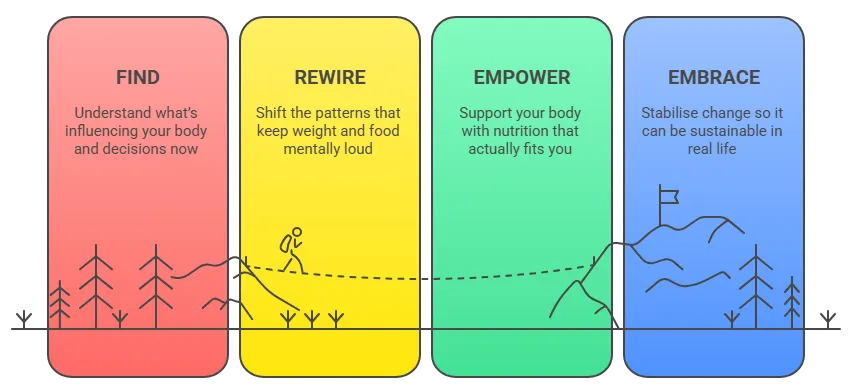
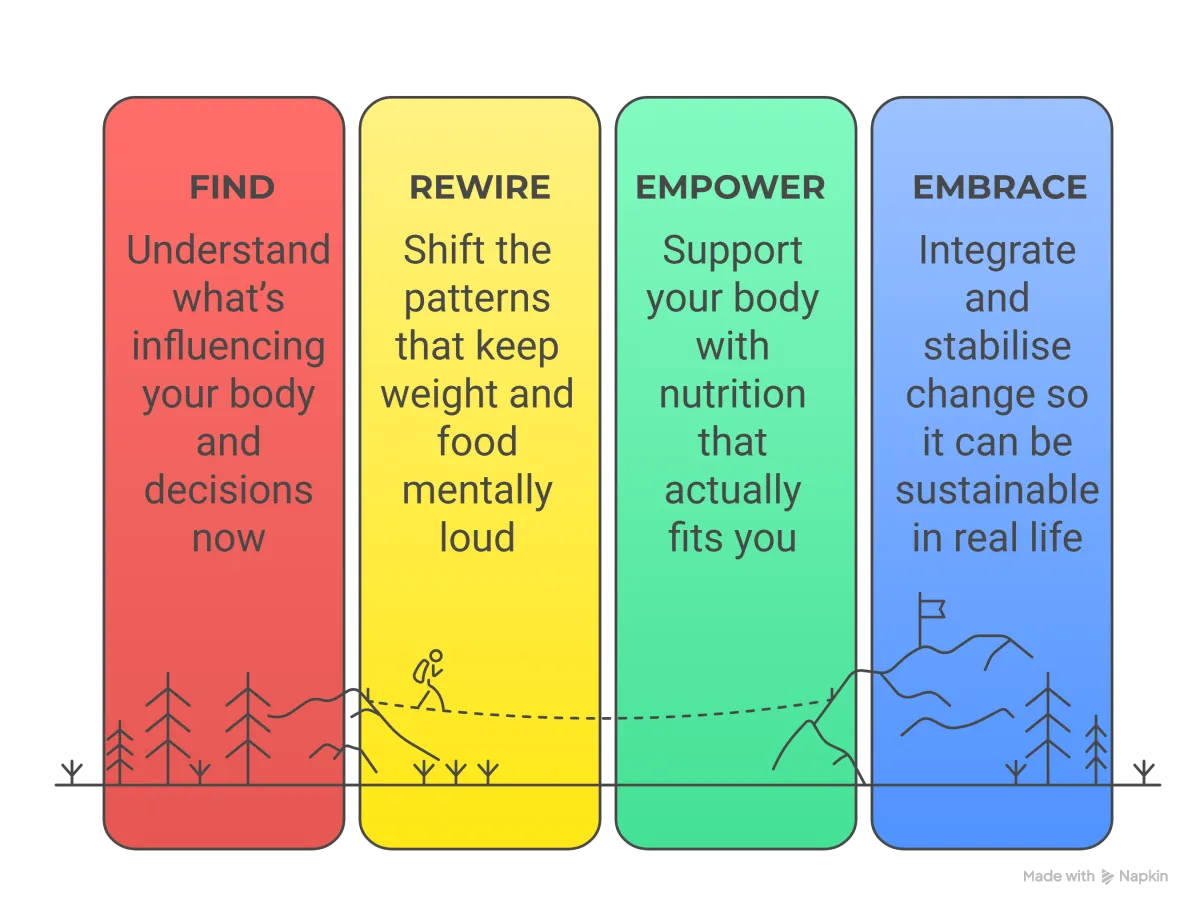
How Mind Your Weight Works
Many women reach a stage where the strategies that once worked for managing weight begin to feel less reliable.
Mind Your Weight is designed to help women understand what may now be influencing weight regulation in midlife, and to apply a structured approach that considers nutrition, behaviour and daily routines together rather than in isolation.
The program coordinates these areas so changes can be applied in everyday life, rather than relying on willpower or short-term focus.
What's Included In Mind Your Weight
Comprehensive Assessment & Personalised Plan
Blood pathology analysis to inform your personalised plan
Structured Sessions
8 focused practitioner-led sessions across the Mind Your Weight program
Ongoing Practitioner Support
Practitioner support between sessions for practical guidance when you need it
Guided Mindset &
Behaviour Tools
Structured hypnotherapy and behaviour tools integrated alongside nutrition
Nutrition App &
Community Access
Ongoing access to your nutrition plan and the Metabolic Balance community
Program Hub & Resources
Central access to personalised tools and resources used throughout the program
Mind Your Weight is delivered with direct practitioner involvement throughout the program. Because of the level of individual attention this requires, places are limited. Up to four women commence each month to ensure continuity, focus, and appropriate scope of support.
Get Started With A Weight & Metabolism Assessment
Entry to Mind Your Weight begins with a structured online strategy session focused on understanding your current context, patterns, and goals. The purpose is clarity and planning, not diagnosis or medical treatment. If Mind Your Weight is appropriate, we outline how it would apply in your situation. If it isn’t, you leave with a clear next step rather than another generic recommendation.
What's Included In
Mind Your Weight
Comprehensive Assessment
& Personalised Plan
Blood pathology analysis to inform your personalised plan
Structured Sessions
8 focused practitioner-led sessions across the Mind Your Weight program
Ongoing Practitioner Support
Practitioner support between sessions for practical guidance when you need it
Guided Mindset &
Behaviour Tools
Structured hypnotherapy and behaviour tools integrated alongside nutrition
Nutrition App &
Community Support
Ongoing access to your nutrition plan and the Metabolic Balance community
Program Hub & Resources
Central access to personalised tools and resources used throughout the program
Mind Your Weight is delivered with direct practitioner involvement throughout the program. Because of the level of individual attention this requires, places are limited. Up to four women commence each month to ensure continuity, focus, and appropriate scope of support.
Get Started With A Weight & Metabolism Assessment
Entry to Mind Your Weight begins with a structured online strategy session focused on understanding your current context, patterns, and goals. The purpose is clarity and planning, not diagnosis or medical treatment. If Mind Your Weight is appropriate, we outline how it would apply in your situation. If it isn’t, you leave with a clear next step rather than another generic recommendation.
Learn the rules like a professional, so you can break them like an artist
- Picasso -
The aim is to build an approach that fits the way your body and life actually work now
FAQS
What happens in the Weight & Metabolism Assessment?
This is a structured, non-diagnostic consultation focused on understanding your current context, patterns, and goals. It does not involve medical diagnosis or treatment. The purpose is to clarify what kind of support may be appropriate. If Mind Your Weight is a good fit, we map how it would apply in your situation. If it isn’t, you leave with clarity on your next step rather than another generic plan.
How is this approach different to what I've tried before?
Many approaches rely on rigid rules or cutting out entire food groups. Mind Your Weight focuses on understanding how your body is functioning now, alongside behaviour change and personalised nutrition. It’s less about pushing harder, and more about working with your physiology and patterns rather than against them.
Do I have to give up the foods I enjoy?
No. This isn’t a restrictive or exclusion‑based approach. Your nutrition is personalised to your needs and preferences, with the aim of making food feel more sustainable and realistic long‑term.
Do I need to exercise for this to work?
Exercise is not a requirement for this program. While movement can be beneficial for health, the program focuses first on nutrition, metabolism, and behavioural patterns. Any activity choices remain personal and should be discussed with your primary care provider where relevant.
What if I’m on medication or managing a health condition?
The program can be adjusted for people managing health conditions or taking prescribed medication. It does not replace medical care, and all medication decisions remain with your doctor. Mind Your Weight is designed to work alongside existing healthcare and may be suitable for some people managing conditions such as diabetes or those using weight-loss medication, subject to individual review.
Who is the program not suitable for?
Mind Your Weight is not suitable for individuals with:
* Eating disorders requiring psychological treatment
* Pregnancy or breastfeeding (please consult your healthcare provider)
* Certain psychotropic medications (eligibility varies)
* Conditions such as advanced kidney disease where specialised care is required
* Strict vegan diets, as the nutrition plans do not align with very strict vegan requirements
Is this suitable if I’m in perimenopause or menopause?
Yes. Many women apply during this stage of life. The program takes into account metabolic and hormonal changes common in midlife and is personalised to the individual rather than a generic template.
How much time does the program require?
Most components are designed to integrate into normal routines rather than add extra pressure. Time commitments are discussed during the intake session so expectations are clear upfront. Appointments typically range from 30 minutes to 2 hours depending on their purpose.
What if mindset work or hypnotherapy hasn't worked before?
In this program, mindset work is integrated alongside nutrition and behaviour change rather than used in isolation. Meditative hypnotherapy is offered as a supportive tool to create awareness around patterns. Some people notice its effects directly, while for others it works quietly alongside the other elements of the program.
Will this still work if I don’t have time to cook elaborate meals?
The focus is on simple, practical food choices. There’s no expectation to cook complex meals or follow rigid recipes.
Is there support to apply this to eating out, travel and family meals?
Guidance is available to help you apply the approach to eating out, travel, and shared meals.
What happens at the end of the program?
The final phase focuses on integration so changes can be carried forward into everyday life. Optional membership plans are available for ongoing support.
What if I don't get the outcome I'm hoping for?
Individual responses vary, which is why the strategy and early sessions focus on clarity and suitability. Support is provided within the scope of the program, and referrals may be suggested where appropriate.
Mind Your Weight Is For Women Over 40
Navigating Hormonal Weight Change
This program may be appropriate if:
You are in midlife and your body feels harder to manage than it used to
You are looking for a personalised process rather than generic advice
You are willing to follow a structured approach over time
It may not be suitable if:
You are looking for a quick or passive solution
You prefer rigid rules or one-size-fits-all plans
You are not in a position to engage in a structured process
It may not be suitable if:
You are looking for a quick or passive solution
You prefer rigid rules or one-size-fits-all plans
You are not in a position to engage in a structured process
MEET OUR PRINCIPLE PRACTITIONER
Hello I'm Natasha
BPsychSc (Hons), BHSc (Naturopathy), BSc (Hons)
Natasha works with women navigating midlife. She recognises this can be a challenging period as bodies change and personal identity often shifts approaching menopause. For many it may mean that weight, eating choices, energy levels, sleep and habits start to feel mismatched.
This is why her work focuses on helping women follow new patterns aligned with their personal experience of this stage of life. She applies the curiosity and careful interpretation of complex data from her science background to weight and metabolic health in midlife, approaching complexity conservatively rather than relying on assumptions, trends, or trial-and-error.
Natasha is currently undertaking postgraduate training in clinical psychology, reflecting an ongoing focus on scope-aware, ethical practice and working with complexity. She offers appointment times outside standard working hours, recognising that regular weekday appointments are not always practical for people with busy lives.

References
1. Chandramouli, A., et al. (2024). Circadian rhythm, chrono-nutrition, and metabolic health: Implications for unhealthy lifestyle patterns. International Journal of Environmental Research and Public Health, 21(4).
2. Décarie-Spain, L., & Kanoski, S. E. (2021). Ghrelin and glucagon-like peptide-1 in food reward and aversion. Nutrients, 13(3), 977. https://doi.org/10.3390/nu13030977
3. Byrne, N. M., Sainsbury, A., King, N. A., Hills, A. P., & Wood, R. E. (2018). Intermittent energy restriction and compensatory responses in weight regulation. International Journal of Obesity, 42, 129–138. https://doi.org/10.1038/ijo.2017.206
4. Meffert, C., & Gerdes, N. (2010). Program adherence and effectiveness of a commercial nutrition program: The Metabolic Balance study. Journal of Nutrition and Metabolism, 2010, Article 197656. https://doi.org/10.1155/2010/197656
5. Soto-Mota, A., et al. (2024). Increased low-density lipoprotein cholesterol on a low-carbohydrate diet in
adults with normal but not high body weight: A meta-analysis. The American Journal of Clinical Nutrition, 119 (3): 740-747. https://doi.org/10.1016/j.ajcnut.2024.01.009
6. Kallio, P. et al. (2008). Inflammation markers are modulated by responses to diets differing in postprandial insulin responses in individuals with the metabolic syndrome. The American Journal of Clinical Nutrition, 87(5), 1497–1503.
Disclaimer: Mind Your Weight is a nutrition, lifestyle, and behaviour education and support program. It does not provide psychological assessment, diagnosis, or mental health treatment. Individual responses vary, and no specific outcomes are implied.
GET IN TOUCH
Availability:
Mon & Thur 6pm - 9pm • Fri 8am - 5pm • Sat 8am - 4 pm • Sun 10am - 2pm
© Two Minds To Thrive, 2026. All rights reserved.
GET IN TOUCH
Availability: Mon & Thur 6pm - 9pm • Fri 8am - 5pm • Sat 8am - 4 pm • Sun 10am - 2pm
© Two Minds To Thrive, 2026. All rights reserved.
Contact Us | Privacy Policy | AI Policy | Terms & Conditions | Website Terms of Use